Essays on Leaves Acquired from the University of Chicago
In the twentieth century, the University of Chicago
special collections processed and held in its collection two leaves
from the Book of Mormon. The leaves are nonsequential. The first
bears text of what is now Alma 3:5–4:2, and the second of what is
now Alma 4:20–5:23. In
summer 1984, the University of Chicago sold these two leaves to The
Church of Jesus Christ of Latter-day Saints. Around the time of the
sale, officials at both the University of Chicago and the church
determined that the leaves were likely authentic pieces of the
original manuscript of the Book of Mormon. Anomalies in the text,
however, have led some to believe these leaves (referred to here as
the “Chicago leaves”) are forgeries. The Chicago leaves have
sometimes been associated with Mark Hofmann, who in the 1980s forged
a number of documents relating to Latter-day Saint and American
history, though there is no evidence that the leaves ever passed
through Hofmann’s hands, nor is there any other documented
connection between the leaves and the infamous forger.
Scholars disagree about the authenticity of the Chicago leaves.
Because of their questioned status, the images and transcripts of
the leaves are presented as an appendix in this volume. We present
by way of introduction to the images and transcripts two
examinations of the evidence, one written by each of the volume’s
editors. With these two essays, readers and scholars may evaluate
for themselves the complex history and characteristics of the
Chicago leaves.
Photographs and transcripts of the leaves
are presented in the same manner as in the
rest of the volume.
Evidence for the Authenticity of the University of
Chicago Acquisition
Robin Scott Jensen
The provenance of the leaves acquired from the University of
Chicago—as well as similarities between the Chicago leaves and other
leaves from the original manuscript and forensic testing performed
on the leaves—strongly indicates that they are an authentic part of
the original manuscript of the Book of Mormon. Further, textual
analysis of the leaves offers important clues as to why some textual
anomalies in the manuscript might exist. While some anomalies in the
text raise questions about the leaves, these anomalies are
explainable and do not outweigh the considerable evidence of the
leaves’ authenticity.
It is unclear when or how the University of Chicago
acquired the leaves, though internal university records indicate
that they were likely “a gift from a noncommercial and
non-professional source.” Asked about the provenance of the
leaves, Robert Rosenthal, the head of the university’s special
collections in the 1980s, stated that “the document had been in [the
University of Chicago’s] collection since the 1920’s.” Rosenthal was very familiar with
the leaves and had in fact taken an interest in them when he began
work at the university in the 1950s. He had even tried,
unsuccessfully, to determine their history prior to their
acquisition by the University of Chicago. Physical evidence supports
Rosenthal’s assertion that the leaves were in the collection by the
1920s: The catalog card describing the leaves, which was created by
university library staff, matches the type and format of other cards
produced by the library from roughly 1923 to 1929. The Chicago leaves had apparently been
processed by special collections staff by the 1950s—a Library of Congress call number
was assigned to the two leaves, and staff assigned such numbers to
items in the codex manuscript collection (of which the Chicago
leaves were a part) only before the 1950s. After a theft in their collections around
1965, Chicago library staff began marking their manuscript holdings
with an invisible security mark meant to be seen under ultraviolet
light. The verso of each of
the Chicago leaves bears this security mark (see figure 1). The
known provenance of the leaves places them firmly in the custody of
the University of Chicago for much of the twentieth century.
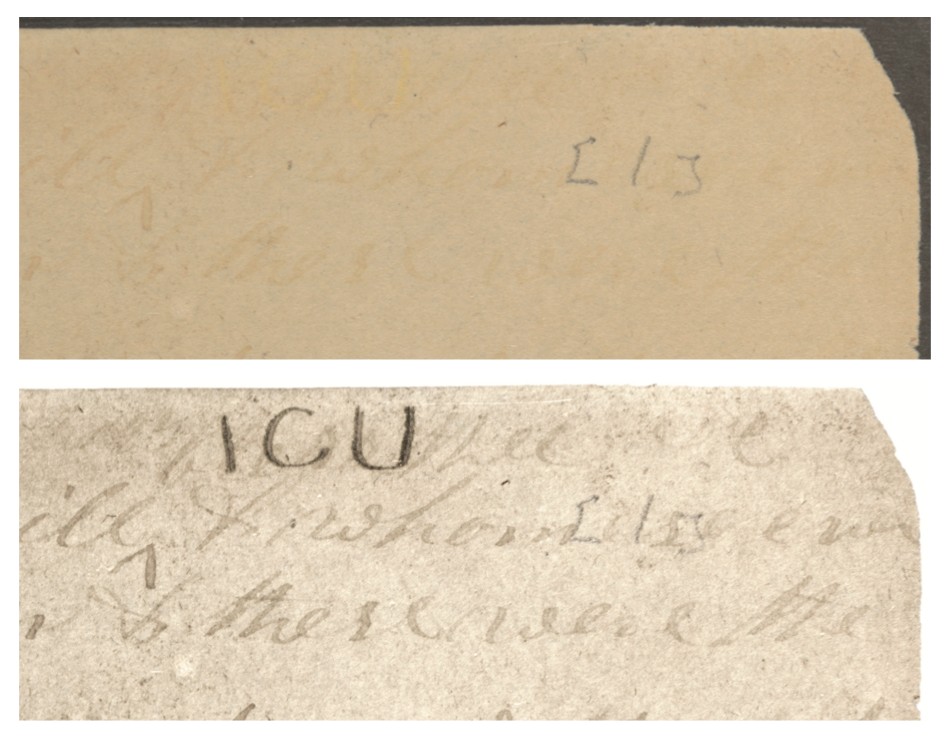
Fig. 1. The upper right corner of page [2] of the University of Chicago leaves under
visible (top) and Ultraviolet light (bottom). The “ICU” security
mark added by the University of Chicago is visible only under
ultraviolet light.
The physical characteristics of the Chicago leaves
closely match those of other pages of the original manuscript in
significant ways. The handwriting on the Chicago leaves appears to
be that of , who acted as scribe
for most of the original manuscript. The two Chicago leaves
measure at their largest 12¾ × 7⅛ inches. No other leaves are extant
from either the gathering that would have contained the Chicago
leaves or any adjacent gathering, making impossible a definitive
comparison to nearby leaves. The full height of the Chicago leaves
does, however, match exactly that of other known leaves from the
book of Alma in the original manuscript. The width of the Chicago
leaves in their original state is not determinable, since the sides
of the Chicago leaves have
been either trimmed or damaged. Manuscripts that underwent
conservation treatment in the mid-twentieth century often had their
edges trimmed.
Damage to the Chicago leaves also matches the pattern
of wear on the subsequent leaves of the book of Alma in the extant
pages of the original manuscript. While some portions of the leaves
are better preserved than others, it appears that the manuscript as
a whole sustained consistent patterns of damage while its leaves
were stored together. When deposited in the cornerstone of the
Nauvoo House, the manuscript was described as being complete,
without mention of any damage.
Over the decades during which it was in the cornerstone, the
manuscript sustained significant damage. Some portions, such as
parts of 1 Nephi, are still mostly intact, while other leaves show
significant wear. Some damage appears throughout many of the
gatherings and likely occurred while the manuscript leaves were all
stored together. For instance, many leaves, including the Chicago
leaves, are missing the upper right portion of the recto and contain
a hole in the lower center portion. The patterns of damage on the
Chicago leaves indicate that the leaves are authentic and were
stored with the other pages of the manuscript when they were
initially damaged (see figure 2). As leaves or gatherings were
handed out piecemeal, those individual portions sustained their own
unique damage, depending on the conditions in which they were stored
or displayed. The Chicago leaves also appear to have sustained
unique damage after they were separated from the rest of the
manuscript. The two leaves appear to have been stored together without the missing middle
leaf for enough time that fragments of the second leaf have adhered
to the first leaf. A small fragment from the second leaf has somehow
become attached to the verso of the first leaf, making it look as if
a hole has been patched near the bottom of the first leaf.
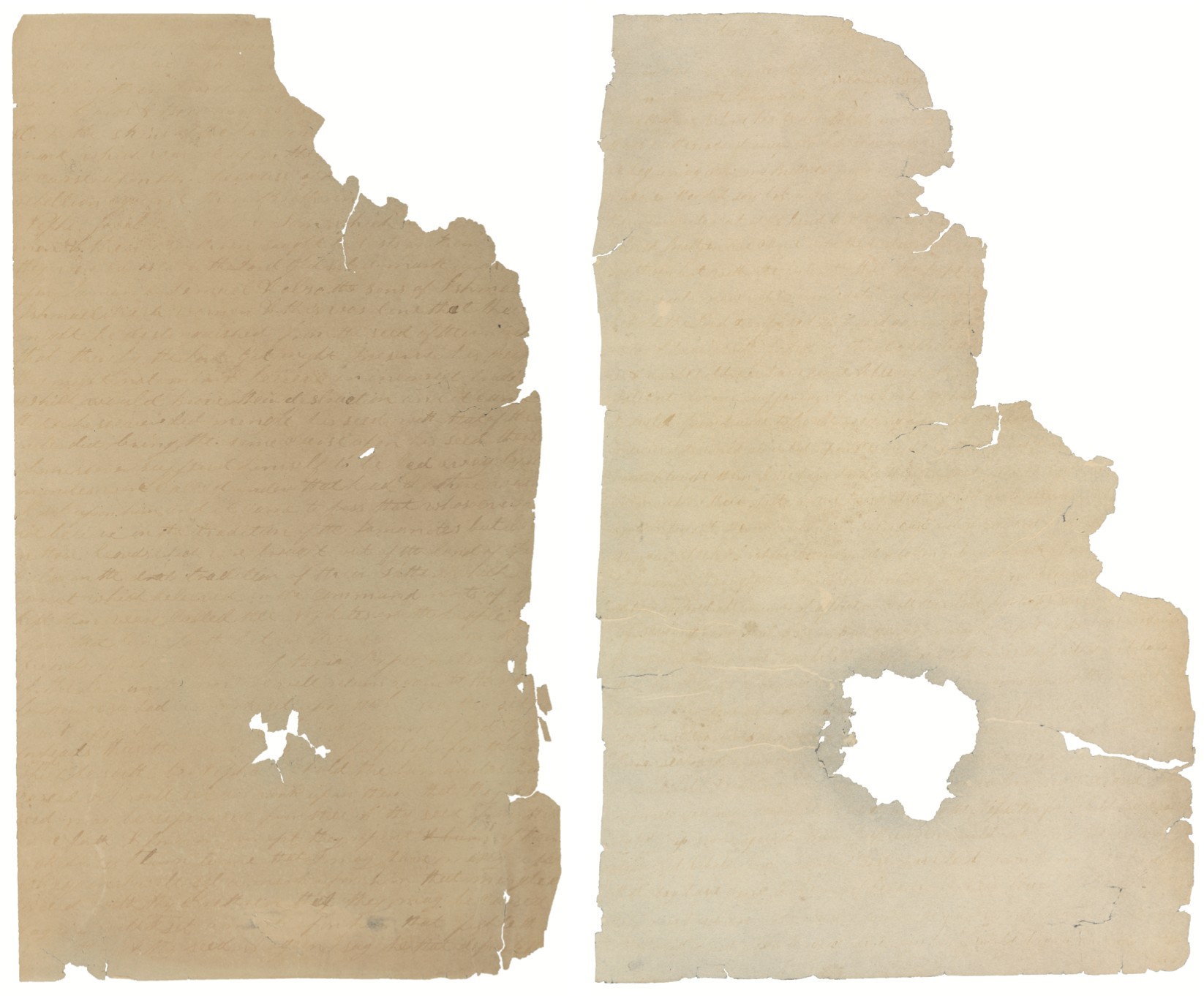
Fig. 2. Damage to the Chicago leaves (left) mirrors the damage to later pages
of Alma in the original manuscript of the Book of Mormon, such as
page [271] (right).
Several years after the arrest of Mark Hofmann, Royal
Skousen alerted leaders of the Church Historical Department to his
belief that the Chicago leaves were forgeries. In 1989, the Church Historical
Department arranged for forensic testing to evaluate the
authenticity of the leaves. George J. Throckmorton, a forensic document
examiner for the Salt Lake City Police Department who had been
instrumental in detecting Hofmann forgeries in the mid-1980s,
subjected the leaves to a battery of tests. His report was
inconclusive.
On Throckmorton’s recommendation, staff at the Church
Historical Department then hired Roderick J. McNeil, an analytical
biochemist, to perform Scanning Auger Microscopy (SAM) on the
Chicago leaves. SAM measures the ion migration of iron gall ink into
the fibers of paper and compares that with measurements of
contemporary documents that are known to be authentic, in order to
determine when the ink was originally inscribed on the paper. McNeil had
assisted in Throckmorton’s mid-1980s investigation of Hofmann
forgeries by performing SAM testing on documents suspected to be
forged. Throckmorton validated McNeil’s methods with a blind test of
documents; he found that McNeil’s analysis matched the known facts
about every one of the documents. When McNeil
analyzed the Chicago leaves in 1989, he concluded that they were
inscribed in 1830, plus or minus five years. McNeil further stated
that “the results from all the samples were very consistent and I’m
confident that the results are accurate.” Summarizing the results of all the testing—and
informed by correspondence with the University of Chicago about the
leaves’ provenance—senior Church Historical Department staff member Glenn N. Rowe wrote in
May 1990 that “all pieces appeared authentic.”
Provenance, physical characteristics, and forensic
analysis firmly establish that the Chicago leaves are at least one
hundred years old and apparently authentic. Textual analysis of the
Chicago leaves raises no strong evidence of their being a forgery.
In fact, some of the analysis reinforces their authenticity; a few
examples will be illustrative, though more could be included.
Several scribal mistakes indicate that the scribe writing on the
Chicago leaves was taking dictation, rather than copying from an
existing text. For instance, when Cowdery wrote “it came to not
<to pass> that not many days,” it seems that
he slipped and wrote what he immediately heard (“not”), failing to
capture the words between “to” and “not.” A
comparison of the text of the Chicago leaves with subsequent Book of
Mormon versions shows no obvious dependencies upon any subsequent
text, meaning that the Chicago leaves were not copied from the
printer’s manuscript, the 1830 edition, or later printed
editions—all of which contain unique, identifiable variations.
Finally, the scribal error rate in the Chicago leaves is similar to
that in other pages of the original manuscript (roughly one
misspelling per forty words), and the types of misspellings in the
Chicago leaves indicate an inexperienced scribe. Several errors in the Chicago leaves are distinct
from the types of mistakes that Cowdery typically made in the extant
manuscript. While there are errors throughout the original
manuscript of the Book of Mormon that are unique to particular
portions of the manuscript, the frequency of those unique errors is
higher in the Chicago leaves than in other portions of the
manuscript. Without the complete manuscript, it is impossible to
make definitive statements about the actual pattern of Cowdery’s
scribal work throughout the original manuscript. It is clear,
however, that the scribe of the Chicago leaves was inexperienced.
One example of a unique misspelling is the word “Morman.” Such a
misspelling is a glaring anomaly given that Cowdery otherwise
spelled “Mormon” consistently throughout the extant portions of the
manuscript, and some might see the error as evidence of forgery. But
the historical context of the creation of the Book of Mormon offers
a plausible explanation for this and several other discrepancies in
the Chicago leaves that might prompt some to claim the text is too
dissimilar to the rest of the manuscript.
After the loss of the initial portion of the Book of
Mormon manuscript, JS resumed dictation beginning at
the book of Mosiah. He dictated an unknown amount of the text of
Mosiah to his wife and his brother before arrived in , Pennsylvania, in early April 1829. It is unknown at what
point in the text Cowdery began taking dictation, but it is quite
possible that he was still settling into his role as scribe when he inscribed Alma 3–5, the
material covered in the Chicago leaves. Cowdery’s inexperience may
help make sense of the spelling of “Morman.” The first instances of
the proper noun “Mormon” following the loss of the initial portion
of the manuscript would have been in what is now Mosiah chapters 18
(twelve instances), 25 (one instance), and 26 (one instance). The
name was still relatively new, therefore, and if Cowdery began
serving as scribe anywhere between Mosiah 19 and 25, the name would
have been almost entirely unfamiliar to him when he got to the book
of Alma. If he began somewhere between Mosiah 27 and Alma 2, the
name would have been completely new to him. Since “Morman” is a
reasonable phonetic spelling and since there are other instances of
misspelling of proper nouns in the Book of Mormon text, such a
misspelling should not, by itself, be considered as evidence the
leaves are inauthentic.
The body of evidence supporting the Chicago leaves’
authenticity is at least as strong as and very often stronger than
the evidence for at least one other fragment of the original
manuscript that is accepted by scholars as authentic. Given the complexity of the relevant issues,
no single category of evidence can be conclusive in establishing the
authenticity of the Chicago leaves. Taken together, however,
provenance, physical characteristics, forensic testing, and textual
analysis strongly point to the Chicago leaves being an authentic
part of the original manuscript of the Book of Mormon.
Evidence against the Authenticity of the University
of Chicago Acquisition
Royal Skousen
The main problem with the two University of Chicago
leaves is that they exhibit too many unique properties, ones that
are exceptional, unexpected, or out of place, either for two leaves
of the original manuscript or for as
scribe. In this brief description, I will list some of these unique
properties. In this analysis, the symbol O
stands for the original manuscript and P for
the printer’s manuscript.
1. Two virtually complete leaves
instead of expected fragmentation. The shape of the
fragmented leaves is extraordinarily inappropriate. It explicitly
follows the shape of the 96-page gathering identified as A12.
As with typical fragmented leaves from gatherings, the outer leaves of A12 (both the first
leaves and the last ones) have disintegrated and broken up into
smaller remaining leaves and fragments. So we get only clumps of
fragments for the beginning and ending of what remains of the A12
gathering. Moreover, we get disintegrated fragments for the two
preceding gatherings (Alma 10:31–13:16 from A10 and Alma 19:3–20:22
from A11). And the same disintegration occurs for the gatherings
following A12: we get those few leaves from the beginning of Helaman
(from A13) and then large fragments in the Wilford Wood collection
from the end of Helaman and smaller fragments from the beginning of
3 Nephi (in A14). Or consider the fragments from 2 Nephi and Jacob
after the B2 gathering: from B3 through B6 the fragments
disintegrate, and in fact they clump together according to their
gatherings. And
the Ether gathering A17 (from the Wilford Wood collection)
disintegrates from both the front and the back of that
gathering.
Overall, the remaining leaves and fragments of O show that the small plates translation was on top and
best preserved for 1 Nephi, but then subsequent gatherings started
to disintegrate, as shown by all the fragments after the B2
gathering (that is, after the Franklin Richards gathering that
covers from 1 Nephi 14 to 2 Nephi 1). The B3 gathering includes the
Ruth Smith fragment, which is without a doubt legitimate. In his
examination of the Ruth Smith fragment in 1993–1994, conservator
Robert Espinosa identified this fragment as having paper type A (the
letter A is his identifying symbol for the
paper type). The surrounding gatherings have this same paper type:
from the Franklin Richards B2 gathering up through all the Wilford
Wood fragments from 2 Nephi through Jacob 4 (that is, from B2
through B5, but not B6, which covers portions of Jacob 6–7 and Enos
and has paper type C).
2. Imitating the fragment pattern at Alma
40–43. So how can we even get two leaves shaped like the
University of Chicago leaves? There is no way that two leaves in the
earlier gathering, A9, could suddenly take on the basic shape of the
A12 gathering that far away unless it had been moved into A12 prior
to O being placed into the Nauvoo House
cornerstone. In fact, based on the size of the hole that is 8–9
lines from the bottom, the Chicago leaves (three leaves originally)
would have been reversibly interleaved between page 302´ and page
307´ of A12. If this had happened, the missing upper and outer
corners should match, but the corners of the Chicago leaves extend
beyond the A12 pattern; that is, all the leaves in the A12 gathering
have a larger missing corner than the two University of Chicago
leaves. To be specific, we get the following differences for the
missing upper and outer corner of each leaf:
| 8 pages in A12 (301´–308´) | 13% of the text | lines 1–16 |
| 4 pages from Alma 3–5 | 8% of the text | lines 1–10 |
The University of Chicago leaves model the A12 ones, but they fail to
represent what could have reasonably happened to these leaves from
A9 as they disintegrated within the Nauvoo House cornerstone.
3. The middle leaf is missing.
Another big surprise is that the middle of the three Chicago leaves
is missing. All three leaves should be intact, but the second leaf
is missing. Where is it? I know of no example of any group of
attached fragments of O (either stuck
together or sewn together) that has lost a nearly completely formed
inner leaf. With the Andrew Jenson fragments, there were originally
five fragments stuck together for Alma 10–13, as well as three fragments originally in the same
condition for Alma 19–20. Apparently when
Jenson took the Alma 10–13 clump apart, the middle third fragment
disintegrated into small fragments, or somehow these disintegrated
fragments stuck to the other fragments and were later removed. In
any event, it does not look like Jenson saved them. On the other
hand, since the two outer leaves for the Chicago acquisition are so
well preserved, its middle leaf should also still exist.
4. A crowded text. There are too
many lines on each page. For these University of Chicago leaves,
which involve a widthwise fold of the original foolscap sheet, wrote 42 or 43 lines of text, which means
that the spacing between the lines was being economized. For other
pages in O with a widthwise fold and where
Oliver Cowdery was the scribe, the number of lines varies from 36 in
A12 to 39 in B2.
5. Trimmed leaves. The two
Chicago leaves are trimmed in the gutter, up to about 1.5 cm,
cutting off the text. The question is why? No other leaves or sheets
of O or P have ever
been trimmed. This difference, of course, cannot be assigned to , the original scribe.
6. The square notch. There is a
square cut in the gutter, an unusual notch, at the beginning of line
4 on the recto of the first leaf. This cannot be the jabbed hole
that would have put in the fold to
stitch the gathering together. Where could this have come from?
7. A papered-over hole in the
original manufactured paper. And then there is the original
hole in the first leaf that resulted from when the paper was
manufactured, near the bottom, centered on line 41, which was
patched up by pasting over the hole a small piece of paper and then
writing right across the patch. I have never seen any scribe or
anyone else taking this kind of trouble to deal with paper holes (or
parchment holes in manuscript books prior to printing). In contrast,
on line 10 of page 42 of O, when came to writing 1 Nephi 21:1, there was a
small hole in the middle of the line, and he simply skipped over the
hole when he wrote the word Mother: “from the
bowels of my Mo( )ther hath he made mention of my name”. For similar
holes in other places in O and P, Cowdery sometimes wrote the next character
above the small hole or below it, but he never made any effort to
patch up the hole.
8. The earliest extant spellings for Mormon
and Lamanites appear to
be distinctly altered. In this document, we have the
earliest extant instances of two very common Book of Mormon names,
including one that occurs in the title of the book:
Mormon written twice as
Morman: When we check every
legitimate instance of Mormon in ’s hand, whether
in O or P, we
find that it is always written as Mormon, smoothly and without any shakiness or
heavier ink flow (in other words, differently from these two
instances of Morman in the Chicago
leaves).
Lamunites and Lamun: The initial spellings for Lamanites and Laman take a u vowel for
the second a. In and of itself, this
is not unusual for :
he sometimes writes “everlasting love” as “everlusting
love”. But we do not transcribe such examples of Lamanites with a u because Oliver never overwrites these u-like a’s as
u’s. But in the Chicago leaves,
every sufficiently extant instance of Lamanites
(all 9 of them) is
spelled as Lamunites. In addition,
one instance of Laman is clearly
written as Lamun.
9. Too many unique misspellings.
When we consider the misspellings and scribal slips in the two
Chicago leaves, we find that 18 of them are strikingly different
from the spelling errors found elsewhere in O
and P. In the following analysis, each of the
unique errors is marked with an exclamation point (!). Whenever no scribe is specified, is assumed to be the scribe. I use the
following abbreviations:
| OC | (scribe 1 of O and scribe 1 of P) |
| JW | (scribe 2 of O) |
| CW | (proposed scribe 3 of O) |
| MH | (proposed scribe 2 of P) |
| HS | (scribe 3 of P) |
Franklin Richards acquisition, pages
263´ and 264´ (only 1 unique error for OC here in Alma
23–24)
| concerning | comcerning | a slip: 2× in O (Alma 23:3 and Alma 47:33) |
| prophecies | Prophesies | 9× in O, 13× in P |
| liveth | lieveth | 2× in O (Alma 23:6, both times), 3× in P |
| miracles | mir[a|u]cles | OC often writes a like u: “everlusting life” at Alma 33:23 in O |
| cities | Citties | 1× in O (Alma 23:13), 3× in P |
| weapons | weopans | 2× in O (Alma 23:13, both times); weopons: 26× in O, 16× in P |
| harden | heard[e|o]n | hearden: 2× in O, 7× in P; heardon: 3× in O, 3× in P |
| whithersoever | whitheersoever | a slip: er > eer: peerhaps (Alma 52:10, in O) |
| cities | Cittis | a slip: es > s (plural): eys, ons, Lamanits, embassis, Nephits, bons |
| ! curse | cures | a slip: se > es: coures [in place of course] (Alma 7:20, by MH in P) |
| stirred | stired | 6× in O, 13× in P |
| anger | angar | 15× in O, 1× in P |
| against | againts | a slip: 2× in O (Alma 24:2 and Alma 51:9), 1× in P (Ether 7:24) |
Ruth Smith acquisition, pages 55 and
56 (only 1 unique error for OC here in 2 Nephi 4–5)
| valley | vally | 15× in O, 32× in P |
| plain | plane | 3× in O, 8× in P |
| encircle | ensircle | 1× in O (2 Nephi 4:33), 1× in P (Alma 48:8); ensirceled: 5× in P |
| stumbling | stumbleing | 1× in O (2 Nephi 4:33), 6× in P |
| putteth | puteth | 1× in O (2 Nephi 4:34), 5× in P |
| exceedingly | excedingly | 22× in O, 71× in P |
| lest | least | 12× in O, 11× in P |
| ! buildings | bildings | bilding: 5× in O by CW; bildings: OC only here in 2 Nephi 5:15 |
Andrew Jenson acquisition, pages
228´–233´ (no unique errors here in Alma 10–13; difficult to
read)
| body | boddy | 8× in O, 1× in P |
| flaming | flameing | 2× in O, 3× in P |
| expedient | expediant | 18× in O, 54× in P |
| preparatory | preperatory | 1× in O (Alma 13:3); preperation(s): 10× in O, 21× in P |
When we examine the Chicago leaves, we get too many
surprises. Many of these are specifically found only in P, in either ’s or ’s hand, namely
and (instead of the ampersand), humbleed, mingleeth, and reccord(s); thus one can argue that the Chicago leaves
used P as a source for some of its
misspellings but assigned them incorrectly to .
University of Chicago acquisition, 4 pages (18 unique
exceptions)
| Amlicites | Amelicites (1×) | 3× in O (Alma 24:1, Alma 24:28, Alma 27:2) |
| ! & | and (3×) | never in O or P except 2× in P when OC overwrote an aborted word; MH and HS both have and along with & |
| armor | armour | 4× in O, 8× in P |
| baptize | baptise | 1× in O, 19 in P |
| ! began | bagan | 0× for all scribes in O and P |
| body | boddy | 8× in O, 1× in P |
| ! bondage | bondge | a slip: 0× for all scribes in O and P |
| declare | declair | HS, 2× in P (Mosiah 29:6 and Alma 5:1); OC, declaired: 2× in O |
| encircle | ensercle | 2× in O, 2× in P; ensercled: 4× in O; enserceled: 4× in P |
| encircle | insercle | 1× in O (Alma 34:16); insercled: 2× in P; insercles: 1× in P |
| experienced | experianced | obediance: 1× in P; disobediance: 2× in O and 2× in P |
| ! filthiness | filtheness | 0× for -eness for all scribes in O and P |
| ! foreheads | forheads | 0× for all scribes in O and P |
| fought | faught | 8× in O, 5× in P |
| ! guilt | gilt | 0× for all scribes in O and P |
| ! have | heave | a slip: 0× for all scribes in O and P |
| having | haveing | 23× in O, 50× in P |
| henceforth | hence forth | 1× in O (Alma 45:17), 5× in P |
| ! humbled | humbleed | 1× by MH in P (Alma 7:3), also by MH: trampleed, dwindleed |
| imagine | imagion | similarly by OC: immagionations, imagionations, imagioning |
| ! Ishmaelitish | Ishmaeliteish | a slip: 0× for all scribes in O and P for the ending -ish |
| ! Laman | Lamun | u clearly written instead of a: 0× for all scribes in O and P |
| ! Lamanite(s) | Lamunite(s) | u overwritten intentionally: 0× for all scribes in O and P |
| living | liveing | 3× in O, 6× in P |
| ! mingleth | mingleeth | 1× by MH in P (Alma 3:15); also by MH: trampleeth |
| ! Mormon | Morman | 0× for all scribes in O and P (never, even as a miswriting) |
| ! preach | spreach | a slip (blending preach and speech): 0× for all scribes in O and P |
| prophesy | prope{s|c}y | a slip, ph > p by OC: propesy: 3× in O; propesies: 3× in O |
| ! record | reccord | reccord(s): 0× for OC in O and P; 1× for MH in P, 2× for HS in P |
| remembrance | rememberanc | a slip, e > 0: audienc by OC in P (Ether 9:5); rememberance: 3× in O, 14× in P; rememberence: 1× in O (1 Nephi 2:24) |
| set | s[a|e]t | sat instead of expected set: 5× in the earliest text |
| separated | seperated | 1× in O, 3× in P |
| sought | saught | 1× in O (Alma 54:13), also 3× in P by MH |
| ! throughout | thruout | 0× for all scribes in O and P; also 0× for through spelled as thru |
| trodden | troden | 3× in O, 4× in P |
| view | vew | vews: 1× in P (2 Nephi 1:24) |
| villages | viliges | 1× by OC in P (Alma 23:14); also 1× by HS in P (Alma 5:0) |
| whomsoever | whomesover | 1× in O (Alma 36:3); also whome 1× in O and 2× in P |
| ! words | wordrs | a slip: no similar slip for all scribes in O and P |
| ! wrought | wraught | 0× for all scribes in O and P |
The Wilford Wood fragments are found on 58 pages of O, in 6 different places in the text, all in
’s hand; these fragments
account for 1.87 percent of the text, yet they contain only 4 unique
misspellings:
| Jacob 2:13 | apparrell |
| Jacob 7:27 | obiediance (or obiedience) |
| Helaman 16:8 | neaver |
| Ether 6:27 | annoint (2×) |
The Chicago leaves cover about 0.71 percent of the text. This means
that the spelling uniqueness for the Chicago leaves is roughly 13.6
times more frequent than what we get for the Wilford Wood fragments.
This is an extraordinary difference.
It is true that we have clear evidence for Oliver
Cowdery learning how to spell better, but this evidence is in P rather than in O.
Cowdery eventually learned to use standard spellings in P only because he was proofing the 1830
typeset sheets against his copy text, which was usually P. In O, on the other
hand, we have examples of him alternating his spelling (or
misspelling) for various words:
body ~ boddy
record ~ reckord
kept ~ cept
need ~ kneed ~ nead
saith ~ sayeth
led ~ lead
lest ~ least
fought ~ faught
dissent ~ desent
dissension ~ desension
anger ~ angar
angery ~ angary [in
place of angry]
Yet for all of these examples, never learned how to spell these words in O. There is only one word in O that Cowdery learned how to spell, exhort (but that occurred only near the end
of his scribing, in 1 Nephi 16–17, and just after had used the correct spelling, in 1 Nephi
15:25). From a statistical point of view, it is virtually impossible
to claim that Oliver Cowdery reduced his exceptional misspellings in
O to 1/13th the frequency in going from
Alma 3–5 to Alma 10–13.
10. Too many odd scribal slips. There are
additional problems with the Chicago leaves, some dealing with
scribal errors that never show up elsewhere in O and P:
Alma 3:20 (on line 11 on the verso of the first leaf):
now it came to not
<to pass> that not many days after
Elsewhere
and other scribes in O and P never miswrite “it came to pass” in
this way. Having written it came to,
they write pass without fail (1,393
times). There are only 6 scribal slips involving “it came to
pass”: (1) the scribe omits the to:
“it came pass” (3 times); (2) the scribe omits the initial
it came: “and to pass” (1 time);
(3) the scribe omits to pass: “it
came that” (1 time); (4) the scribe miswrites to as be: “it
came be pass” (1 time). Cowdery makes all of these errors
except for one instance of “it came pass”; in each of his
cases he immediately corrects his error.
Alma 4:1 (on lines 36–37 on the verso of the first Chicago leaf):
Now it came to
pass
Chapter <II>
Now it came to pass in the six sixth year of the Reign
of
There are 31 extant instances of chapter
beginnings elsewhere in O, from which
we can see that whenever JS came to
the beginning of a new chapter in his dictation, he
consistently told the scribe to write the word Chapter, and only then did JS start
to dictate the text of that new chapter, which the scribe
typically wrote down on a new line (29 times) but sometimes
on the same line after the chapter specification (2 times,
in the book of Ether). The situation here in Alma 4:1 is
unique, where either JS failed to dictate the word Chapter or the scribe failed to first
write down the word Chapter before
starting to write down the text of the new chapter.
Alma 5:14 (on lines 11–12 on the verso of the second Chicago leaf):
have ye spirit<ual>ly been [born of Go]d
There are only 2 instances in the manuscripts
where accidentally
miswrote an adverb ending in -ly: (1)
in O for 1 Nephi 19:2 he wrote particually in place of particularly, making a mess of the
final syllable for the adjective particular; (2) in P for
Moroni 10:17 he wrote severly instead
of severally, skipping the al of the final syllable of the
adjective several. In both these
cases, we have a simple scribal slip, and in neither case
did Cowdery correct his scribal slip (he may not even have
noticed it). But here in Alma 5:14, the error is clearly
objectionable: the -ly is directly
added to the noun spirit rather than
to the correct adjective spiritual,
thus creating the bizarre word spiritly, which is corrected.
11. Oddly written letters. There
are a large number of odd ways in which writes certain letters in the Chicago
leaves, ones that are not found elsewhere in his handwriting in O and P. For instance,
I note the following oddities for just the recto of the first leaf:
| line 12: | unusual extra loop in the s for also (also on line 3) |
| line 12: | unusual e in the first the |
| line 19: | unusual loop on the b of bring |
| line 24: | second r of Rcords is unusual |
| line 25: | unusual the |
| line 26: | unusual h in the |
| line 27: | unusual loop on the r of or |
Continuing in my transcript for the Chicago leaves, I
list about 30 similar oddities for the three other pages of this
document (including unusual letter forms, extra flourishes and
strange swirls as well as loops on letters, and even a loop
encircling a whole word). Most words may look like they are ’s, but there are also too many unusually
written words. This extensive phenomenon never appears in any of
Cowdery’s handwriting on other extant leaves and fragments of O.
One could propose an untested—in fact,
untestable—hypothesis here: is at
the beginning of his scribal work in the Chicago leaves, and
consequently he is creating all kinds of exceptions and oddities as
he takes down JS’s dictation. By adopting this
hypothesis, one can safely ignore all the unique spellings, weird
syntactic errors, and oddly written letters in the Chicago leaves,
along with the crowded text. No matter the uniqueness in the
handwritten text, it can be assigned to Oliver Cowdery’s beginning
as a scribe and thus dismissed. In this way, we can get rid of any
cases that we find inconvenient. Yet setting aside all these cases
of proposed uniqueness in the Chicago leaves means that no internal
textual evidence can ever disprove or call this document into
question. And this allows a weak provenance to trump all contrary
internal evidence from the written text itself. It is important to
remember that the provenance of the University of Chicago
acquisition comes down to the following fact: it was never publicly
known until its discovery in the early 1980s, in the same period
when numerous dubious documents (including other apparent fragments
from the original manuscript of the Book of Mormon) were suddenly
making their appearance. It is better to ignore this document until
all these oddities can be truly explained instead of simply
dismissed.